What Is the Most Common RV Repair? Top Causes
Last Updated: November 7, 2026
Quick Summary
The most common RV repair is fixing water intrusion from worn roof seals, which includes resealing around vents, seams, and rooftop AC units. Water that gets past these seals can rot wall framing and damage floors, so catching it early keeps repairs cheaper.
Roof leaks cause more RV repairs than almost any other single problem.
Watch for ceiling stains, soft floor spots, musty smells, and cracked sealant around vents.
A ceiling stain usually means water has already moved past the roof into the walls.
Roof reseal costs run about $300 to $1,200, depending on rig type.
Is your RV leaking or losing power?
Sharp RV Services offers mobile repair and maintenance for RVs across Pinellas County.
Table of Contents
The Most Common RV Repair: Roof Seals and Water Intrusion
Roof leaks cause more RV repairs than almost any other single problem.

Roof seal problems are among the most frequent issues on RVs.
Quick answer: The most common RV repair is resealing the roof and fixing water intrusion around vents, seams, and fixtures.
Watch for these warning signs:
Brown or yellow stains on ceiling panels or wall corners
Soft or spongy spots in the floor near the wall edges
A musty smell that does not go away after cleaning
Cracked or chalky sealant around vents and the AC unit
Bubbling or lifting at the roof membrane seams
Watch out: a stain on the ceiling usually means water has already moved past the roof. Check the wall framing and floor before you assume the problem is small.
Other Frequent RV Failures by System
Roof leaks are the most common repair, but they are not the only one. Most RV problems fall into a few systems: plumbing, electrical, HVAC, the chassis, and the appliances. Each one fails in its own way.
Plumbing: pump failures, leaking fittings, and clogged drains
Electrical: dead outlets, weak batteries, and tripped breakers
HVAC: air conditioners that stop cooling or run without airflow
Chassis: brake wear, tire damage, and wheel bearing problems
Appliances: refrigerator cooling loss and water heater faults
Plumbing and Water Pump Problems
The water pump is the heart of the RV plumbing system. When it starts to fail, the faucet may sputter, lose pressure, or run on and off with no water flowing. Leaks at fittings and the water heater connections are also common.
Start with simple checks. Make sure the freshwater tank is full and the water pump switch is on. Look under the sink and around the water heater for drips. Many leaks that look like pump trouble are actually loose fittings you can tighten yourself.
Electrical, Battery, and Power System Faults
Electrical problems are a close second in frequency. Dead batteries cause most of the no-power calls. Corroded terminals, a failing converter, or a weak battery bank can each leave you with dead lights and outlets.
Check the battery voltage and clean the terminals before you do anything else. If the problem continues, a technician can test the converter and wiring. Power issues that involve the house and chassis systems together usually need a professional eye.
Common RV Repairs and Costs by Type of Rig
Treating every RV as the same rig is the fastest way to misjudge what will break and what it will cost. Motorhomes, travel trailers, and fifth wheels carry different systems, different loads, and different failure patterns.
Rig type | Most frequent repairs | Typical cost range (parts and labor) |
Class A motorhome | Roof seals and water intrusion, slide-out mechanisms, leveling jacks, generator service, chassis and brake work | Roof reseal $400-$1,200; slide-out repair $300-$1,500; jack replacement $500-$1,800 per leg; generator service $200-$600 |
Class C motorhome | Roof and cab-over seam leaks, house battery and converter faults, AC and furnace issues, chassis brakes and tires | Roof reseal $350-$1,000; converter replacement $250-$700; AC repair $200-$900; brake service $300-$800 per axle |
Travel trailer | Roof and seal leaks, plumbing and water-pump failures, axle and tire problems, frame and floor water damage | Roof reseal $300-$900; water pump replacement $150-$400; axle or spring repair $300-$1,000; floor repair $500-$2,500 |
Fifth wheel | Landing gear and hitch problems, slide-out faults, roof seals, water heater and refrigerator failures | Landing gear repair $400-$1,200; slide-out repair $300-$1,500; water heater replacement $500-$1,200; fridge cooling unit $800-$2,000 |
The final cost depends on the rig's age, how accessible the failed part is, whether the damage spread, and local labor rates. A roof reseal on a 20-foot trailer is a different job than a full reseal on a 40-foot motorhome with three vents, a skylight, and two AC units.
Which failures are urgent and which can wait
Not every repair carries the same risk. Sort the problem before you sort the price.
Stop use and get service immediately:
Brake or tire failure, or any vibration or pull that appeared suddenly
Propane smell, a hissing fitting, or a water heater that will not stay lit
Burning smell, hot outlet, or repeated breaker trips
Active water intrusion, a wet ceiling, dripping vent, or water running down a wall
A slide-out that will not lock or is sagging on one side
Schedule service soon but keep using with care:
A water pump that cycles but still delivers pressure
One dead outlet on an otherwise working circuit
An AC unit that cools weakly but still runs
A refrigerator that works on electric but not propane, or the reverse
Manageable with monitoring:
Chalky or cracked sealant that is not yet leaking
A slow drain or a faucet that drips
Cosmetic cracks in a vent cover or skylight
Watch out: water damage is the one category where waiting almost always raises the bill. A $300 reseal caught early can become a $2,500 wall and floor repair once the framing stays wet for a season.
How RV type changes the diagnosis
A motorhome carries its own engine, transmission, and chassis, so drivetrain and brake work shows up alongside house-system repairs.
That is why the honest answer to "what is the most common RV repair" depends on the rig in front of you. Roof and water intrusion lead across all three classes, but the second and third most common repairs shift with the type of coach.
RV Refrigerator Repair Cost: What to Expect
RV refrigerators fail in predictable ways, and the cost tracks the failure, not the brand. Most units are either absorption (propane and electric) or compressor (12-volt or residential-style), and the two fail differently.
Failure | Typical cost range (parts and labor) |
Dirty burner, clogged flue, or blocked vent | $100-$250 |
Thermistor or control board replacement | $200-$500 |
Door seal or hinge replacement | $150-$350 |
Cooling unit replacement (absorption) | $800-$2,000 |
Compressor or sealed-system repair | $600-$1,500 |
Full refrigerator replacement | $1,200-$3,500 |
Access matters: a fridge buried behind a cabinet or under a counter takes more labor than one with a clear service panel. Age matters too, on an older unit, a cooling-unit replacement can cost more than the fridge is worth, and replacement becomes the better call.
How to tell what failed before you pay for a diagnosis
Start with the simple checks that separate a cheap fix from an expensive one.
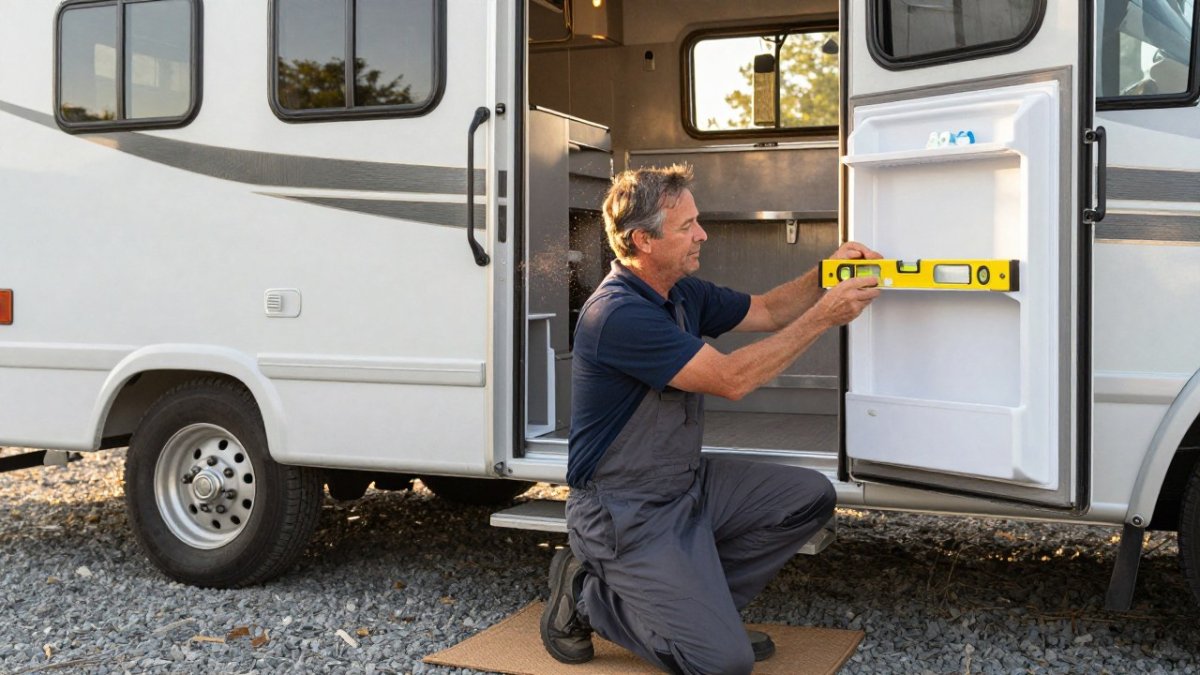
Confirm the fridge is level. Absorption units need to be close to level to circulate refrigerant. A rig parked off-level for days can stop cooling with nothing actually broken.
Check the vent and flue. Dust, mud-dauber nests, and lint block airflow. A clogged flue or dirty burner is one of the least expensive fixes on the list.
Test both power sources. If the fridge cools on electric but not propane, the problem is in the burner or gas valve, not the cooling unit. If it fails on both, suspect the cooling unit or control board.
Look for yellow residue or an ammonia smell. That points to a failed absorption cooling unit and means the fridge should be shut off.
Check the thermistor. A failed thermistor can make a working fridge run warm or freeze everything. It is a low-cost part.
Watch out: if you see yellow staining or smell ammonia near an absorption refrigerator, stop using it and ventilate the rig. That is a cooling-unit failure, and continuing to run it can damage the unit further.
When to repair and when to replace
A general rule of thumb: when a repair costs a large share of the price of a new unit and the fridge is aging, replacement often makes more sense than repair.
For a compressor-style or 12-volt fridge, compressor and sealed-system work is usually worth doing on a newer unit but rarely on an older one.
Sharp RV Services can inspect the unit and give you a quote based on the actual failure, the parts required, and how hard the fridge is to reach, so you can compare repair against replacement with real numbers instead of a guess.
DIY RV Repairs for Beginners: What You Can Safely Handle
Some RV repairs are safe for a beginner. Others need a professional. Knowing the difference saves time and avoids damage.
Safe for beginners:
Cleaning refrigerator vents and burner areas
Tightening loose plumbing fittings
Checking and cleaning battery terminals
Replacing light bulbs and fuses
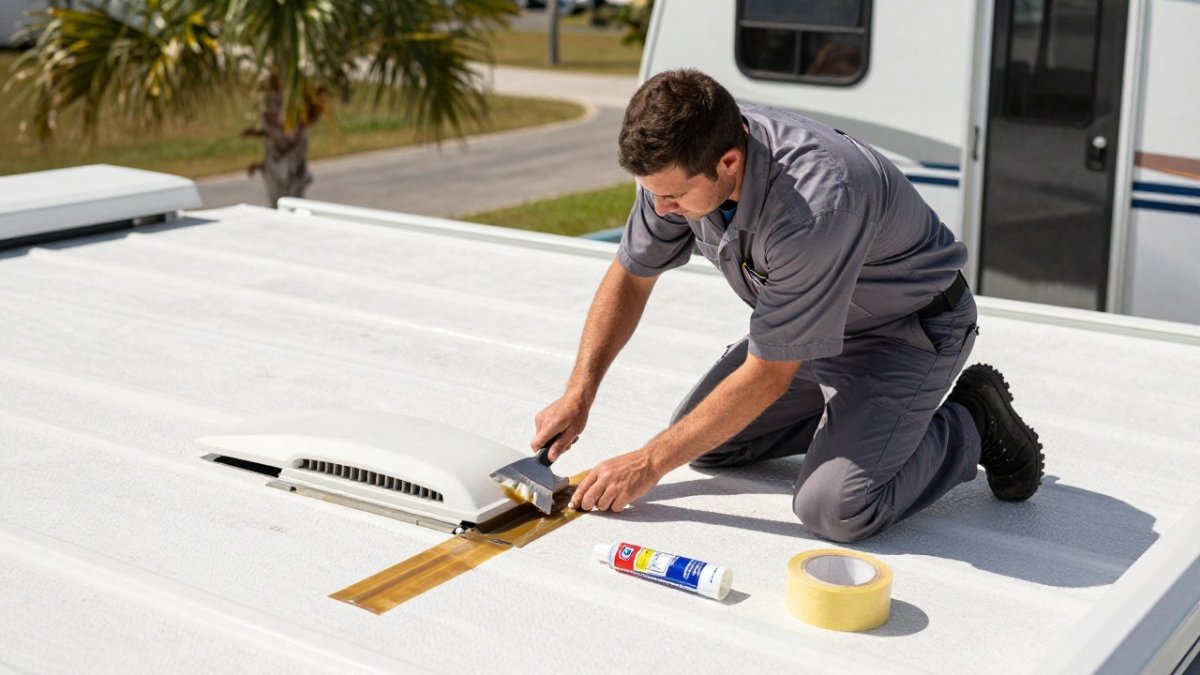
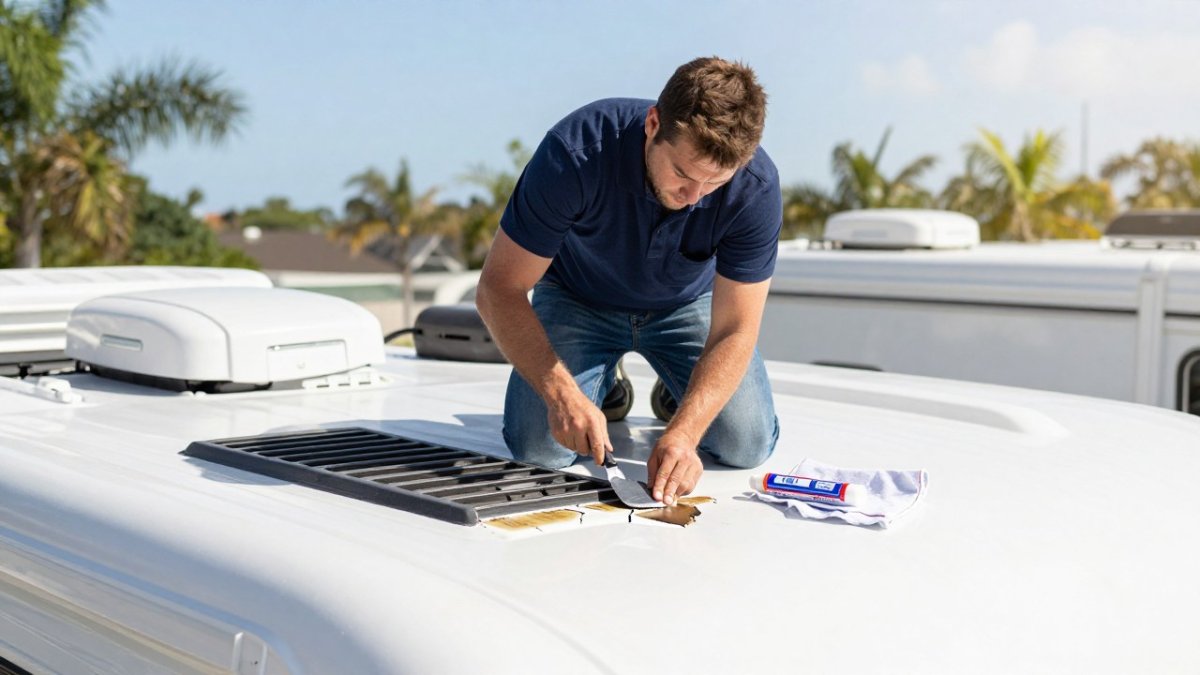
Resealing small areas of sealant around vents
Leave these to a technician:
Roof membrane repairs and full reseals
Propane and gas line work
High-voltage electrical and converter repairs
Brake, axle, and tire work
Any repair involving structural damage
Watch out: propane and high-voltage work can cause fires and injuries. If you are unsure, stop and call a professional.
RV Repair Labor Rates and When to Call a Technician
Labor rates vary by technician, location, and the complexity of the job. A simple fix may take an hour. A full roof reseal or a multi-system diagnosis can take much longer.
Call a technician when a problem involves water damage, gas, high-voltage wiring, or the chassis. Also call when a DIY fix does not solve the issue or when the cause is unclear. Early help often costs less than a repair that has spread.
Scheduling Your RV Inspection and Maintenance Plan
Regular inspections catch most of the problems covered above before they grow. A good plan checks the roof and seals at least twice a year, tests the batteries and electrical system, looks for plumbing leaks, and confirms the refrigerator and AC are working.
Sharp RV Services offers mobile repair and maintenance for RVs throughout Pinellas County, so you do not have to haul your rig to a shop. To schedule an inspection or get a quote, contact Sharp RV Services and request an appointment.
RV Industry Association guidance on RV maintenance
Frequently Asked Questions
What are the most common RV repairs?
The most frequently reported RV repairs involve the roof and water systems, including worn roof sealant, leaking vents and windows, failing water pumps, and clogged or leaking plumbing fittings. Electrical problems such as dead batteries, weak converters and faulty outlets are also common, as are air conditioner and refrigerator malfunctions. Frequency varies by rig age, climate and how often the vehicle is used, so a routine inspection is the best way to identify which of these applies to your RV. Start with the roof and seals, since water damage tends to multiply the cost of every other repair.
Can I fix common RV problems myself?
Many beginners can handle simple tasks such as resealing a vent with lap sealant, replacing a fuse, cleaning a refrigerator condenser coil, or swapping a water filter. More involved work, including gas appliance lines, main electrical panels, brake and axle components, and roof membrane replacement, should be left to a qualified RV technician. Always disconnect power and water before working on any system, and stop if you smell propane or see signs of electrical damage. Working carefully on the simple items saves money without putting you or your rig at risk.
When should I call an RV repair technician?
Call a technician whenever a problem involves propane, the main electrical system, the chassis or brakes, or any sign of structural water damage. Soft spots in the floor or ceiling, persistent musty odors and staining around windows are warning signs that moisture has already spread. Repairs that require special tools or manufacturer diagnostic software also belong with a professional. If you are unsure whether a fault is safe to handle, a mobile technician can usually assess it on site and tell you what it will take to fix.
How can I prevent common RV repairs?
Inspect the roof, seals and caulking at least twice a year and after any storm, and reseal anywhere the sealant is cracked or peeling. Flush the water system, use a water filter, and winterize properly if you store the rig in cold weather. Test batteries and propane connections regularly, clean refrigerator coils, and lubricate slide-out rails and leveling jacks as the manufacturer recommends. A written maintenance schedule with dates keeps these tasks from slipping, and it helps catch small issues before they become expensive repairs.
Comments