What Causes an RV Refrigerator Not to Cool on Propane
Quick Summary
What causes an RV refrigerator not to cool on propane is usually a gas supply or heat problem: a low or empty tank, a closed gas valve, a dirty burner, a blocked flue, or a failed igniter. Each one stops the heat that powers an absorption refrigerator, so the cooling unit never gets warm enough to work.
Check the propane level and confirm the tank valve is fully open first.
Test other propane appliances; if they struggle too, the problem is in the supply.
A steady blue flame indicates a healthy burner; yellow or weak flames point to restriction.
If the unit cools on AC but not propane, the cooling unit is likely fine.
Stop immediately and leave if you smell gas, and call a professional for valve or leak issues.
Table of Contents
Why an RV Refrigerator Stops Cooling on Propane
Last Updated: November 12, 2026
What causes an RV refrigerator not to cool on propane? The most common causes are a low or empty propane tank, a closed or partly closed gas valve, a dirty burner, a blocked flue, or a failed igniter.
Absorption refrigerators do not use a compressor.
Here are the symptoms most owners notice first:
The refrigerator compartment stays warm even on the coldest setting
The freezer works but the fridge does not get cold
The burner does not light, or the flame keeps going out
The unit cools on AC power but not on propane
The cabinet feels warm on the outside near the back vent
A common mistake is assuming the cooling unit has failed when the real problem is a propane supply issue. Start with the simple checks below before you assume the worst.
Checking Propane Supply and Gas Flow First
Before you touch the refrigerator itself, confirm that propane is actually reaching the appliance. Many "refrigerator problems" turn out to be a gas problem somewhere in the RV.
Work through these checks in order:
Check the propane level in the tank. A tank that looks full may still be low. Use a gauge or a tank scale to confirm how much gas is left.
Confirm the tank valve is fully open. Turn it all the way counterclockwise. A valve that is only partly open can starve the appliances.
Check the regulator. Look for frost, ice, or a regulator that seems to be working harder than normal. Those can signal a supply problem.
Test other propane appliances. Light the stove or furnace. If they also struggle, the problem is likely in the supply line or tank, not the refrigerator.
Check the refrigerator's gas valve. Make sure the valve on the refrigerator is open and the control knob is set to propane mode.
Watch out: If you smell gas at any point, stop immediately. Shut off the tank valve, open windows, avoid flames or switches, and leave the area before you investigate further.
Propane flow problems can also come from debris in the line or a worn regulator. Those are not safe to fix on your own.
Inspecting the Burner Flame, Burner Tube and Flue
Once you have confirmed that gas is flowing, look at the burner. The flame tells you a lot about what is happening inside the cooling unit.

A healthy burner flame is steady and mostly blue, with a small yellow tip at most.
Here is how to inspect the burner area safely:
Turn off the refrigerator and let the unit cool before opening any access panel.
Look at the burner tube. Check for soot, spider webs, mud dauber nests, or other debris that can block the flame.
Check the flue. The flue is the vent that carries exhaust gases out of the RV. A blocked flue can cause the refrigerator to shut down as a safety measure.
Look for soot marks around the burner or on the cabinet back. Heavy soot can mean incomplete combustion.
Insects and debris are a surprisingly common cause. RV owners who park outdoors in warm months often find wasp or mud dauber nests in the vent or flue.
Watch out: Do not poke into the burner or flue with metal tools while the gas is on. Turn off the gas before any cleaning, and only use a soft brush or a vacuum.
Testing the Igniter, Spark Electrode and Gas Valve
If the burner will not light, the problem may be the ignition system rather than the gas supply.
Most RV absorption refrigerators use either a manual lighter or an automatic igniter. An automatic igniter sends a spark to the burner when you press the ignition button.
To check the ignition system:
Make sure the refrigerator is set to propane and the gas valve is open.
Press the ignition button and listen for a clicking sound.
Look for a spark at the electrode. A weak or missing spark can mean a dirty electrode, a loose wire, or a failed igniter.
If the spark appears but the burner still does not light, check whether gas is reaching the burner.
The gas valve controls how much gas reaches the burner. A valve that is stuck, partly closed, or failing can cut the flame down to a level too low to cool the unit.
A common mistake is replacing the igniter when the real problem is a dirty electrode or a loose wire.
Why the Freezer Works but the Refrigerator Stays Warm
On most RV absorption refrigerators, the freezer compartment sits at the top of the cooling unit and the refrigerator compartment below it. The ammonia mixture absorbs heat first at the freezer evaporator, then continues to the refrigerator evaporator.
Use this decision tree to narrow it down:
Does the unit cool on 120-volt AC but not on propane? If yes, the cooling unit and thermostat are probably fine, and the fault is in the LP supply, burner, flue, or ignition system. Go back to the propane supply and burner checks.
Does it fail to cool on both AC and propane? The problem is likely in the cooling unit, the control board, or the thermostat, and it usually needs a qualified technician.
Does it cool on both but the refrigerator compartment stays warm? Check leveling, door seals, and ventilation before suspecting the cooling unit.
Check these items in order:
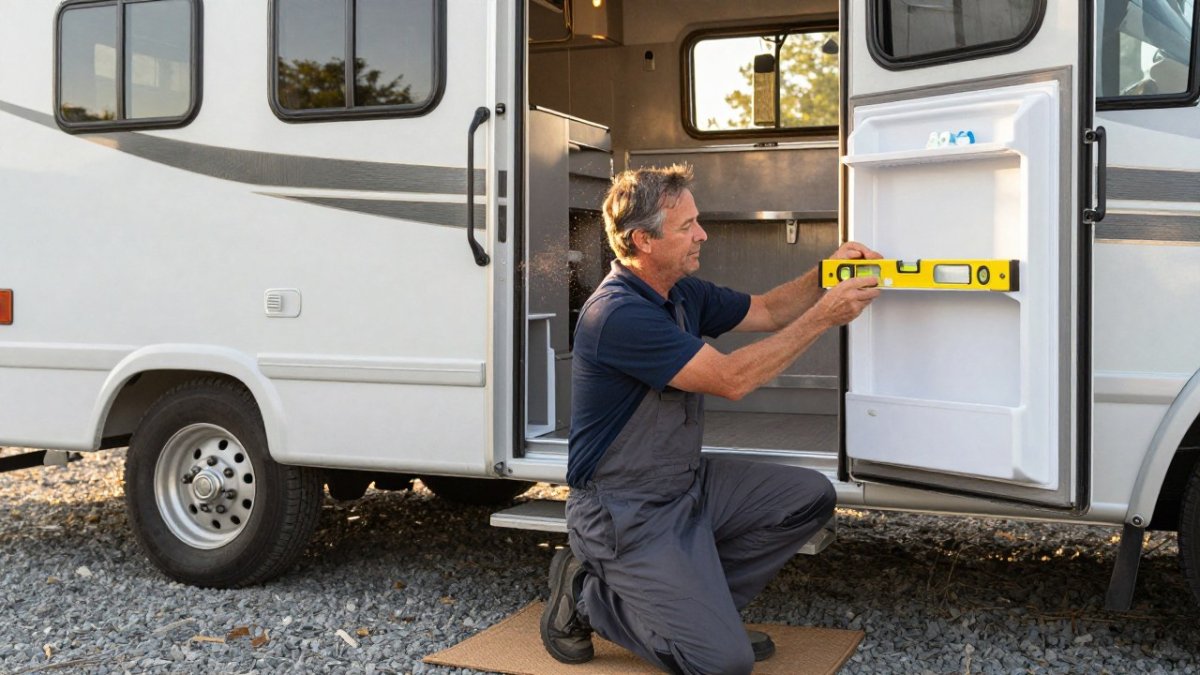
Level the RV. Absorption refrigerators depend on gravity to return the ammonia solution to the boiler. A tilt of more than a few degrees side to side can slow the cycle. Park on a level pad or use leveling blocks, then give the unit several hours to recover.
Check the door seal. A cracked or loose door gasket lets warm, humid air in and makes the compartment harder to cool. Close the door on a dollar bill and pull it out; if it slides easily, the seal is weak.
Look at the vent area. Blocked vents on the outside of the RV trap heat and reduce cooling performance. Clear any obstructions and confirm the vent fan, if equipped, runs.
Review the thermostat setting. Set the control to a middle setting, then wait several hours before judging the result. A setting that is too low can cause the unit to cycle off before the refrigerator compartment reaches temperature.
Check the thermistor. On many models, a small thermistor clipped to the fin inside the refrigerator compartment tells the control board how cold it is. If it is loose or misplaced, the board may think the compartment is colder than it is and cut the flame back.
These causes can make the freezer look fine while the fridge stays warm, so do not assume the whole system is working just because one section is cold. A common mistake is replacing the cooling unit when the real problem is a weak flame or a unit that is out of level.
How Long Cooling Should Take and Temperature Targets
Absorption refrigerators are slow by design. Unlike a compressor fridge that can pull down to temperature in under an hour, an RV absorption unit moves heat through a sealed ammonia-water-hydrogen cycle that depends on a steady flame and gravity.
Use these targets as a starting point, and confirm the exact numbers in your owner's manual because they vary by model:
Area | Typical Target | What It Means |
Refrigerator compartment | 34°F to 40°F | Safe food storage; check with an appliance thermometer |
Freezer | 0°F to 10°F | Ice stays firm; a freezer that only reaches 20°F is marginal |
Cooling time after start-up | 4 to 8 hours | Longer in ambient temperatures above 90°F |
First noticeable cooling | 1 to 2 hours | The freezer plate should feel cold to the touch |
Outside vent | Warm but not scorching | Heat should rise steadily from the flue |
For food safety, the U.S. Food and Drug Administration recommends keeping refrigerator temperatures at or below 40°F and freezer temperatures at or below 0°F (the FDA).
Watch out: Do not judge performance in the first hour after a restart.
When the Problem Runs on Gas or Electric, and When to Call a Professional
Some refrigerators can run on propane, 120-volt AC, or both. This can help you narrow the problem.
If the refrigerator does not cool on either propane or electric power, the problem may be in the cooling unit, the thermostat, or the control board.
Call a professional when:
You smell gas or suspect a leak
The burner flame looks wrong after cleaning
The gas valve or igniter seems faulty
The refrigerator still does not cool after the simple checks
The problem keeps coming back
Sharp RV Services provides mobile repair and maintenance for all types of RVs throughout Pinellas County. Owners who want to compare repair options can read a RV refrigerator repair cost review before deciding. A mobile RV AC repair guide can also help if the cooling problem is part of a larger issue with the RV's systems.
Pricing depends on the problem, the model, and the work needed. For current pricing or a quote, visit the services page or contact Sharp RV Services directly.
If you are weighing whether to repair or replace the unit, review 7 best RV refrigerator brands for full-time living to see how different models compare.
For a full step-by-step approach, read how to troubleshoot and repair an RV refrigerator.
Frequently Asked Questions
Why is my RV refrigerator not cooling even though it's on propane?
The most common causes are low or interrupted propane flow, a dirty or misaligned burner, a blocked flue or vent, a weak or failed igniter, or a faulty gas valve. Start by confirming your propane tanks have fuel and the regulator is open, then look at the burner flame. A steady blue flame indicates good combustion, while a flickering, yellow or weak flame points to a cleaning or supply issue. Because absorption units rely on heat to cool, any interruption in gas delivery or combustion stops the cooling cycle even though the cabinet still feels cool from residual cold.
Why does my RV fridge freezer work but the refrigerator stays warm?
On many absorption RV refrigerators the freezer compartment is cooled first, so a partially working cooling cycle can keep the freezer cold while the main compartment warms up. This often points to inadequate heat input at the burner, poor ventilation around the cooling unit, or a level problem that disrupts the ammonia circulation. Check that the unit is level side to side and front to back, confirm the vent openings are clear, and inspect the flame. If the freezer stays cold and the refrigerator does not, the cooling unit may be partially restricted and warrants professional inspection.
How long should an RV refrigerator take to cool down?
After being turned on from a warm state, many RV absorption refrigerators need several hours to reach a safe food-storage temperature, depending on ambient temperature, model and load. Food storage safety generally calls for the main compartment to be at or below 40 degrees Fahrenheit. Use a standalone thermometer rather than the unit's dial, and expect longer cooling times in hot Florida weather. If the unit has not reached target temperature after a full day running on propane, stop and troubleshoot rather than continuing to wait.
When should I call a professional for an RV refrigerator that won't cool?
Call a qualified RV technician if the burner flame is weak or absent after cleaning, if the igniter does not spark, if you smell gas, or if the flue or vent area shows soot or heat damage. Also call a professional if the unit runs on propane but not electric, or the freezer works while the refrigerator stays warm after you have checked level and airflow. Sharp RV Services provides mobile service in Pinellas County. For current pricing or to schedule a visit, contact Sharp RV Services directly through its website.
Comments